New York authorities have successfully repatriated a collection of 36 invaluable antiquities, collectively valued at more than $5 million, to the people of Syria. The announcement, made by the Manhattan District Attorney’s office on Wednesday, marks another significant milestone in ongoing international efforts to recover cultural heritage items lost to war, looting, and illicit trafficking networks. Among the repatriated treasures is a rare stone relief originating from the ancient desert city of Palmyra, alongside a stunning series of Roman-era mosaics that were once tied to a prominent international antiquities dealer.
The return of these cultural artifacts underscores the persistent global challenge of combating the illegal antiquities trade, particularly in regions devastated by armed conflict. The Wednesday restitution event brought together investigators and cultural heritage advocates to celebrate the recovery of items that hold profound historical, artistic, and national significance for Syria.
Central to the group of returned artifacts are 14 extraordinary mosaics stolen from a Roman-era villa located within Syrian territory. These intricately crafted pieces were linked by investigators to Georges Lotfi, an antiquities dealer who previously maintained a complex relationship with the Manhattan District Attorney’s Antiquities Trafficking Unit. In what proved to be a dramatic turn of events, Lotfi transitioned from being an occasional source of information for investigators to becoming a primary target. In 2022, he was officially charged by New York authorities with the criminal possession of stolen artifacts originating from both Syria and Lebanon. Currently, Lotfi remains at large and is wanted by both New York law enforcement authorities and Interpol.
The Wednesday restitution package featured several standout centerpieces of classical and ancient art, most notably a monumental section of flooring dating back to the 3rd century BCE. This massive and culturally significant mosaic depicts the wedding of the god Telete and Eros, portrayed in the company of Aphrodite and the Three Graces. The exceptional floor panel had been seized by investigators in 2021 from a storage unit owned by Lotfi in the New York area.
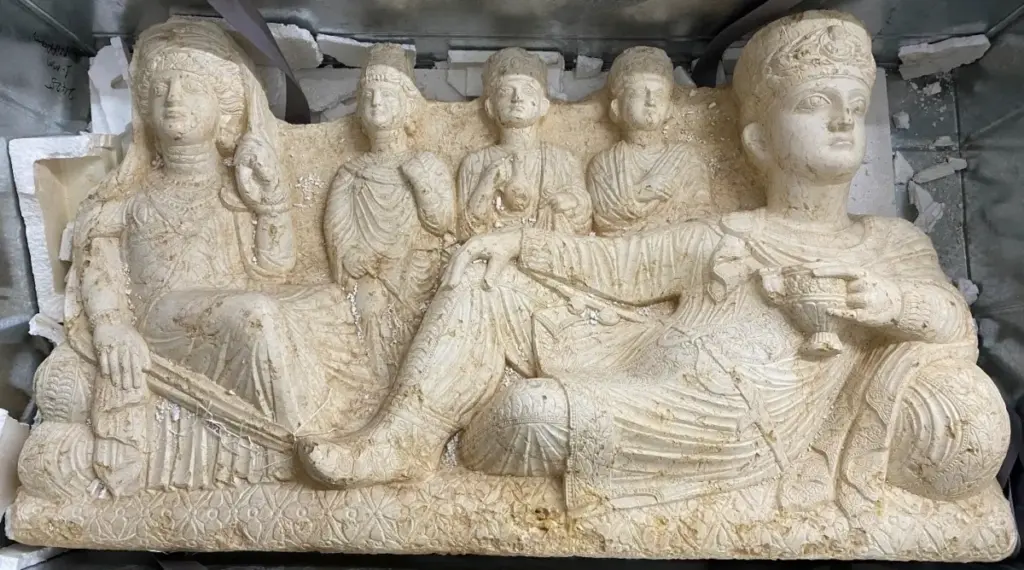
Another crown jewel of the repatriation is the Palmyra relief, a soaring limestone sculpture designed and created for a burial chamber during the late 2nd century CE. The monumental piece depicts a reclining man attended by women and children. Weighing more than 1,000 pounds, the relief bears the physical scars of its illicit extraction; Manhattan investigators believe it was aggressively hacked straight from the wall by looters who left the central human figures intact for maximum black-market value.
Following its removal from the ancient burial chamber, the relief was smuggled out of war-torn Syria and ultimately transported into Dubai. This looting and smuggling occurred before the catastrophic destruction of Palmyra by ISIS between 2015 and 2017, making the survival and recovery of the sculpture all the more poignant for historians and the Syrian cultural community. The return of the relief ensures that a tangible piece of Palmyra’s rich and diverse architectural history is preserved and eventually restored to its rightful home.
In conjunction with the announcement regarding the Syrian antiquities, Manhattan District Attorney Alvin L. Bragg, Jr., revealed a parallel enforcement action involving one of the world’s premier cultural institutions. Bragg announced that his office had seized 13 additional pieces from the Metropolitan Museum of Art. This latest seizure brings the total number of antiquities confiscated from the renowned museum by the D.A.’s office since 2017 to more than 402 items. According to official valuations provided by the district attorney’s office, the cumulative worth of all antiquities seized from the Met over this multi-year period exceeds $98.7 million.
The ongoing cooperation between the Manhattan District Attorney’s Antiquities Trafficking Unit and the Metropolitan Museum of Art represents a significant shift in how major cultural institutions address historical acquisitions that lack transparent provenance. Rather than resisting the investigations, the Met has increasingly leaned into collaborative efforts to audit its vast collections and identify objects that may have entered the art market through illicit channels.
Back in July, representatives from the Metropolitan Museum of Art described these seizures as part of an ongoing, cooperative partnership between the museum and the D.A.’s office aimed at purging its galleries and storage facilities of looted items. Museum officials have acknowledged that historical collecting standards often fell short of modern ethical benchmarks, prompting the institution to actively rectify past acquisitions.
"The Met doesn’t want any stolen art in our collection," Lucian Simmons, head of the Met’s dedicated team of 12 provenance experts, said in a statement released earlier this year. Simmons emphasized the critical role played by local law enforcement in uncovering hidden histories, noting that the district attorney’s office has been an invaluable partner in this work. Specifically, Simmons highlighted the office’s unique investigative reach and its ability to unlock information, track international wire transfers, and access records that would otherwise be entirely inaccessible to museum curators and private researchers.
The dual developments announced on Wednesday—the successful return of multi-million-dollar heritage items to Syria and the continued accountability measures at the Metropolitan Museum of Art—highlight the far-reaching impact of New York’s specialized antiquities unit. As investigations continue and international networks are dismantled, law enforcement agencies and cultural institutions alike face a persistent reminder of the complexities involved in preserving and protecting global art history.