By Benjamin Blake Evemy / MutualArt
October 02, 2026
The German master Franz Ritter von Stuck—a visionary who moved with equal facility between the roles of painter, printmaker, architect, and sculptor—remains one of the most enigmatic figures of the late 19th and early 20th centuries. Renowned primarily for his masterful command of mythological themes, Stuck did not merely illustrate the legends of antiquity; he breathed into them a psychological volatility that transformed the canvas into a portal. His work invites the viewer on a captivating journey into a dark, Symbolist universe where ancient mythologies, raw human desires, and profound psychological turmoil collide. While artists have drawn upon the well of myth for centuries, the distinctive, atmospheric intensity with which Stuck executed his subjects pulls the viewer headfirst into realms that feel at once primordial and deeply, unsettlingly modern.
The Duality of Myth and Flesh
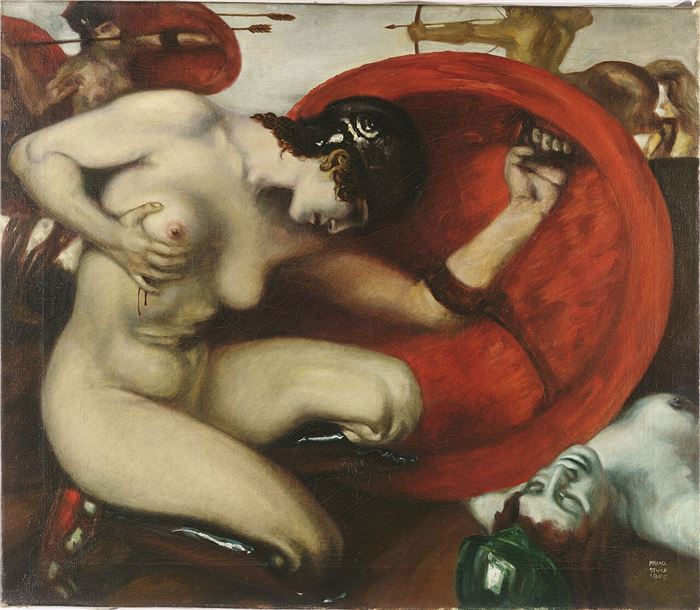
Stuck’s artistic power often resides in his ability to reconcile the epic scale of legend with the intimate, visceral realities of human suffering and desire. A prime example of this synthesis is his 1905 oil on canvas, Wounded Amazon. The work depicts a member of that legendary race of warrior women in the midst of a brutal, bloodied confrontation with Centaurs. As she sinks to her haunches, clutching at her right breast—a gesture that oscillates between physical agony and a strange, haunting sensuality—the viewer is confronted with the stark reality of the conflict. Darkened blood seeps from an unseen wound, while her fallen comrade lies supine nearby, a pale cadaver still frozen in the act of supporting a shield.
The painting serves as a masterclass in the duality that defines the Amazonian mythos: a blend of formidable, unyielding physical strength and a complex, often tragic femininity. Although this specific battle scene does not appear in any singular classical text, it effectively captures the essence of the antagonistic relationship between these two mythological tribes and the heroes of ancient Greece. Stuck’s treatment of the subject forces the audience to confront the intersection of violence and vulnerability, a recurring motif in his broader body of work.
The Burden of Eternity: Sisyphus
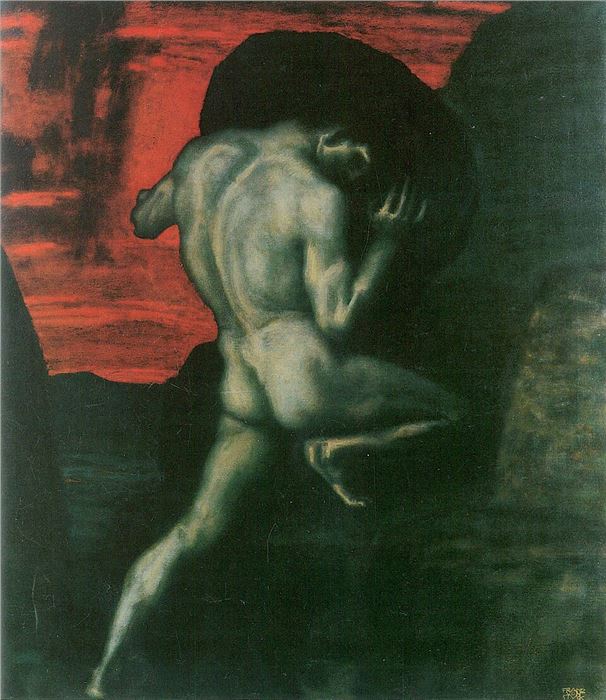
If the Wounded Amazon explores the fragility of the body, Stuck’s 1920 depiction of Sisyphus delves into the crushing weight of the human spirit. The myth of Sisyphus—the king condemned by the gods to roll a massive boulder up a steep hill for eternity, only to watch it tumble back down at the very moment of success—is perhaps the ultimate archetype of futility.
Stuck’s interpretation is hauntingly poignant. Set against an infernal, blood-red sky streaked with charcoal clouds, the figure of Sisyphus is rendered with a gloom-cast countenance and a muscular, strained physique that speaks of a total lack of respite. The cold, corpse-pale flesh of the reprobate, set against the ink-black abyss of Hades, creates a visceral contrast. It is a work that perfectly captures the "sempiternal plight" of the subject, stripping away the abstraction of the myth to reveal the raw, agonizing reality of a task without end.
Divine Light and Fallen Grandeur
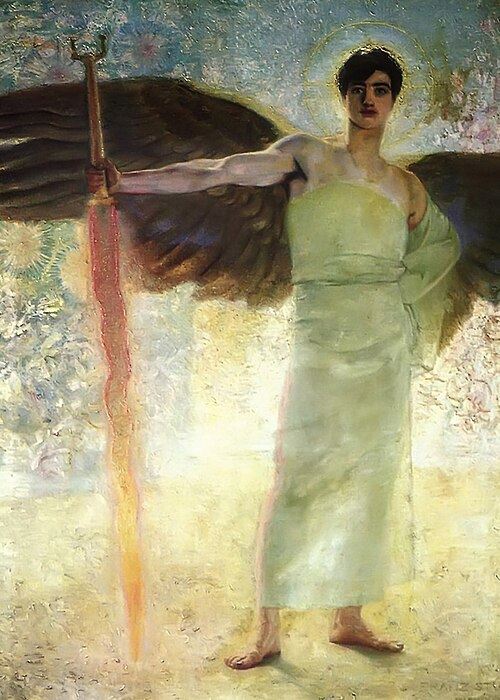
Stuck’s range, however, was not confined to the suffering of mortals. In his 1889 painting, The Guardian of Paradise, the artist showcased a mastery of light and spiritual authority that earned him significant acclaim early in his career, including a prestigious gold medal at the Glaspalast in Munich. The piece features an angel standing with a searing sword, wings outstretched, and a gilded halo encircling an androgynous, serene face. The light of paradise spills forth in a cascade of albescent, star-dusted brilliance. It remains a definitive personification of divine purity, a reassuring counterpoint to the darker, more chaotic elements of his later work.
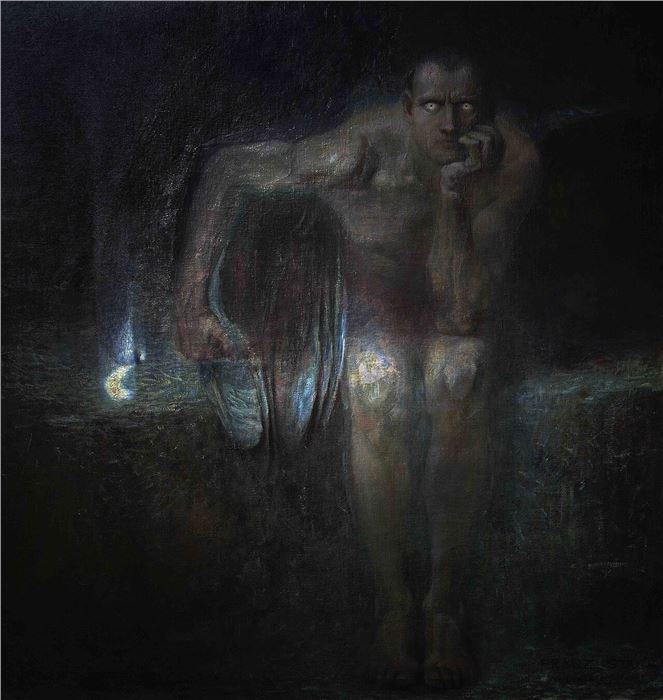
Yet, Stuck was perhaps most famous for his fascination with the darker side of the celestial order. His 1890 masterpiece, Lucifer, remains one of the most chilling portraits in the history of Symbolism. The fallen angel gazes out from the canvas with piercing eyes—black pinpricks set within off-white irises—that seem to fixate directly upon the viewer. While his posture mimics the traditional "thinker," there is an unmistakable, molten rage simmering beneath the surface. Stuck’s subtle genius is evident in the tension of the figure’s clenched right fist and the strained muscles of his arm. The surrounding environment—metallic blues that shimmer across his wings and cascade like liquid water—adds an eldritch quality to the scene. An oversized teardrop falling from the darkness, casting a crescent-moon reflection, serves as a profound analogy for the Morning Star’s cataclysmic fall from grace.
The Allure of Sin
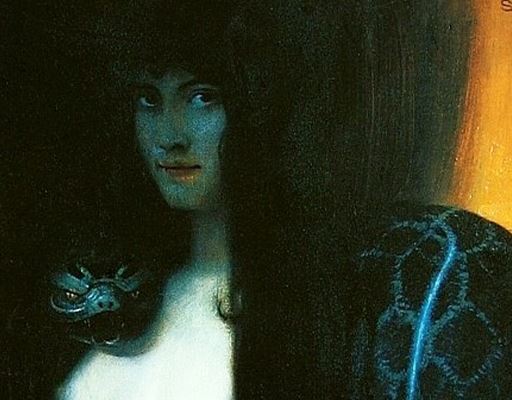
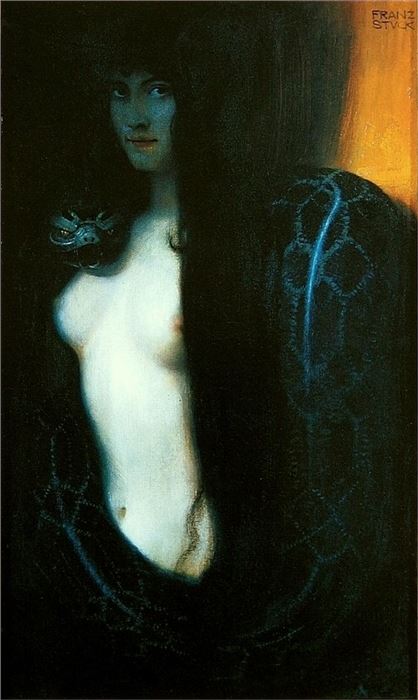
Perhaps no work better encapsulates Stuck’s psychological depth than his 1893 painting, The Sin. Featuring Eve draped in the coils of a serpent, the painting presents a figure who feels far removed from the traditional, subservient wife of biblical narrative. Instead, this Eve bears a striking resemblance to the figure of Lilith—seductive, knowing, and dangerous. The contrast between the "leech-black" skin of the serpent and the pallid, luminous flesh of Eve creates an intense chiaroscuro that draws the viewer into a space of irresistible tension between Eros and Thanatos.
The psychological impact of The Sin is profound; it was a work that fascinated the era’s intellectuals, with figures such as Carl Jung praising the painting for its masterful admixture of anxiety and carnal desire. Stuck clearly recognized the power of the motif, producing nearly a dozen variations throughout his career, one of which was enshrined on his personal Künstleraltar.
A Legacy Intertwined with History
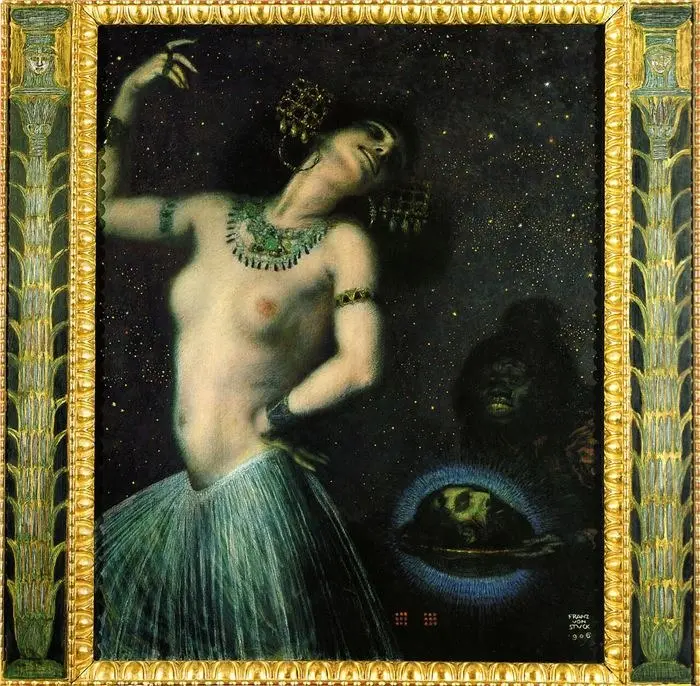
As his career progressed, Stuck’s work became increasingly intertwined with the darker currents of the 20th century. His 1906 Salome—a depiction of the biblical figure dancing beneath a star-filled sky as the severed head of Saint John the Baptist is presented to her—is a masterwork of suggestive power. The elongation of her neck, the curve of her body, and the smudged, alluring eyes all underscore the sway she held over King Herod.
The history of these works is as complex as the paintings themselves. The third version of Salome, for instance, remains missing, lost in the chaos of World War II. The disappearance of art during the conflict is a historical tragedy, but the case of Franz von Stuck is particularly notable given his posthumous association with the rise of the Nazi regime. Stuck was reportedly a favorite painter of Adolf Hitler, and some historians have gone as far as to suggest that the dictator modeled aspects of his public image after the figures in Stuck’s 1889 painting, Wilde Jagd—a coincidence that has invited endless speculation regarding the prophetic or darker interpretive nature of the artist’s legacy.
Ultimately, Franz von Stuck’s departure from the rigid technical accuracy of the Neoclassicists allowed him to transcend the limitations of the medium. His paintings are not merely "models in costume" bound by the constraints of the canvas; they are complete, fully realized worlds. Whether through the agony of a wounded warrior or the brooding rage of a fallen angel, Stuck possessed the singular ability to entice the viewer, only to pull them, all-consumingly, into the depths of the human psyche. His work remains a testament to the power of the Symbolist movement to bridge the gap between ancient mythology and the eternal, often hidden, desires of the human heart.