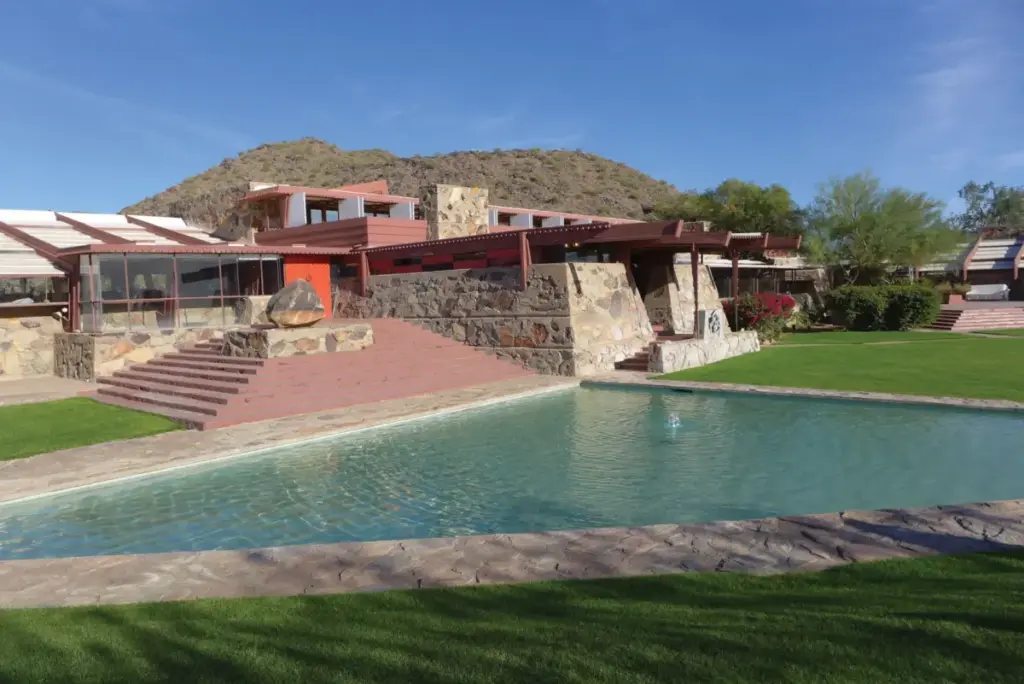
Frank Lloyd Wright’s iconic Taliesin West estate in Scottsdale, Arizona, has announced a temporary closure to the public following a tragic accident that resulted in the death of a visitor during a walking tour on Friday afternoon. The incident, which local authorities and foundation officials are treating as a weather-related accident, occurred amidst severe regional winds that dislodged roofing materials from one of the historic structures on the sprawling desert property.
The individual who lost his life has been identified as Rogério Renato Mateucci, who served as the rector of the Pontifical Catholic University of Paraná in Brazil. According to information provided by the Scottsdale Fire Department, the fatal incident unfolded at approximately 2:00 p.m. local time. Mateucci was participating in a group walking tour of the landmark architectural complex when sudden, powerful wind gusts swept through the area, dislodging a portion of the roof and striking him. Emergency responders confirmed that Mateucci died instantly from the impact.
At the time of the tragedy, meteorological conditions across the region were notably severe. Local television weather broadcasters had designated the day as a First Alert Weather Day, a status utilized by weather forecasting teams to warn the public and travelers about upcoming atmospheric conditions that have the potential to disrupt normal activities, travel, and safety. Data from the National Weather Service indicated that sustained east winds in the Scottsdale area were blowing at approximately 22 miles per hour, accompanied by aggressive gusts reaching up to 32 miles per hour. Despite the intensity of the winds and the presence of other visitors on the grounds, no other injuries or fatalities were reported among the remaining members of the walking tour group or the staff on site.
In the wake of the tragedy, leadership at the Frank Lloyd Wright Foundation moved swiftly to address the public and offer condolences to the grieving family. Joe Spector, the CEO of the foundation, issued a statement to local news outlet AZ Family, expressing deep sorrow over the event. Spector stated that the foundation extends its deepest condolences to the family and loved ones of the individual, adding that out of respect for the family’s privacy and to allow law enforcement and safety officials to complete their ongoing investigation, no further operational details would be shared immediately.
The foundation also took to social media, sharing an update on Instagram to inform the public of the situation and the immediate operational changes at the site. The post confirmed that the Scottsdale Police Department is fully aware of the incident and is cooperating with the property management. As a precautionary measure and out of respect for all involved, the historic property has been officially closed to the public until further notice, halting all scheduled tours and public programs while officials evaluate the site and ensure structural safety following the severe weather event.
Taliesin West holds a monumental status in the worlds of American architecture, culture, and history. The legendary architect Frank Lloyd Wright originally established the desert camp, studio, and home in 1937, envisioning it as his winter laboratory and personal sanctuary in the remote foothills of the McDowell Mountains in Scottsdale. Wright continued to reside and work at the property during the winter months until his passing in 1959.
Spanning an expansive 491 acres of rugged Sonoran Desert landscape, the architectural masterpiece is celebrated globally for its organic architecture, seamlessly integrating into the natural topography using local desert rocks and redwood. The site has long attracted international scholars, architecture enthusiasts, and tourists eager to experience the visionary environment where Wright and his apprentices lived and designed some of the twentieth century’s most influential buildings. The cultural significance of Taliesin West has been recognized through major historical exhibitions over the decades. Notably, in 1940, New York’s prestigious Museum of Modern Art showcased a complex representing the property, followed by another prominent display of photographs capturing the unique structures in 1947, cementing the estate’s legacy as an architectural wonder long before its designation as a UNESCO World Heritage site and a beloved modern landmark.
As investigations by local authorities and safety inspectors continue at the site, the surrounding architectural and academic communities mourn the sudden loss of Rector Mateucci, while the Frank Lloyd Wright Foundation remains focused on cooperating with officials and ensuring the safety of its grounds before welcoming visitors back to the historic desert campus.