At the very beginning of every residential design project, a fundamental question must be asked: Will this home still be serving its inhabitants beautifully in 20 years? That single query requires an expansive vision that accounts for far more than the individuals currently sitting across the design table. The clients signing the contract today are typically vigorous, busy, and entirely confident in their own physical mobility. Yet, the home they are building or remodeling will inevitably host aging parents on a holiday visit, a friend recovering from sudden surgery, a grandchild just learning to navigate a flight of stairs, or a teenager dealing with an unexpected sports injury. Thoughtful, comprehensive design means creating spaces for everyone who will eventually walk through that front door, embracing the full trajectory of human experience rather than a fleeting snapshot of current health and capability.
As an industry, residential architecture and interior design have become extraordinarily sophisticated at catering exclusively to the present. Professionals know expertly how to source the right rare stone, layer the right atmospheric light, and calibrate the exact proportion of ceiling height to overall room volume. What the trade remains far less practiced at is designing for the complete arc of a human life—anticipating not just the life a client is living right now, but the chapters they have not yet reached. This forward-looking philosophy shifts the paradigm of luxury from superficial aesthetics to enduring functionality, health, and safety seamlessly integrated into the built environment.
Health: The Specifications Nobody Photographs
Materials matter in profound ways that the mainstream design press rarely covers. The paints specified for the walls, the chemical adhesives binding the flooring, and the subtle off-gassing emanating from newly installed cabinetry are not abstract, harmless concerns. Indoor air quality has a direct, measurable effect on human cognitive function, sleep quality, and long-term respiratory health. Specifying low-VOC and zero-VOC materials is not merely a gesture toward environmental virtue or passing trends; it is a critical health decision for a family who will breathe that exact indoor air every day for the next thirty years.
Acoustic comfort and thermal zoning belong squarely in this same vital category of unseen health infrastructure. A home that suffers from chronic acoustic chaos is a home operating under persistent, low-level stress. Similarly, a kitchen floor that radiates harsh cold during winter months is more than merely unpleasant; cold feet flinch and shift weight rapidly, which is precisely how accidental slips and falls begin in high-traffic domestic zones. By addressing these foundational sensory and environmental factors during the specification phase, designers protect the long-term well-being of the occupants in ways that go far beyond what meets the eye on camera.
Wellness: Light as Medicine
Of all the wellness levers readily available to a modern designer, light is arguably the most powerful and yet the most consistently underestimated. Years of studying circadian-responsive lighting lead to one inescapable conclusion: the light within a home is either working harmoniously in tune with human biology or actively working against it. Warm, low-level light in the evening hours supports the natural wind-down that a human body desperately needs before falling into restorative sleep. Conversely, cool, brighter light in the morning signals wakefulness to a nervous system that is still fundamentally calibrated to the rising sun.
The WELL Building Standard strongly backs this biological reality, noting that evening light levels should ideally drop below 50 equivalent melanopic lux, while daytime levels should reach 200 or more, mirroring how the eye’s non-visual light receptors—known as intrinsically photosensitive retinal ganglion cells, or ipRGCs—signal alertness or rest. Tunable LED systems, often referred to as warm-dim or comfort-dim technology, are routinely specified in forward-thinking projects, though often selectively rather than in every single room. Because this advanced technology still carries a genuine financial upcharge over standard single-color LED fixtures, clients can occasionally feel skeptical at the initial proposal stage. However, those same hesitant clients tend to become absolute evangelicals within just a few weeks of actually living with the dynamic system in their daily routines.
Safety: Design That Doesn’t Announce Itself
True professional expertise in wellness and aging-in-place design often stems from a deep-seated professional frustration. Too many beautiful homes eventually transform into domestic obstacles—spaces that proudly celebrate how their owners lived at age fifty while quietly betraying them by the time they reach seventy. A zero-threshold shower entry, a sturdy handrail subtly built into what reads purely as an architectural design detail, a door lever with a gentle return instead of a traditional round knob, and grab bars properly disguised as functional towel bars attached with specially engineered structural fasteners are all hallmarks of preventative design.
The translation problem invariably begins the exact moment the phrase "aging in place" enters a client conversation. Clients understandably point out what exceptional physical shape they are currently in and express their firm intention to stay that way indefinitely. The designer’s true job is to completely reframe the entire conversation. The goal is never about designing for limitation or frailty; rather, it is about designing for permanence and protecting the fundamental right to stay in the home you love without being forced to endure a disruptive, expensive renovation at the exact moment in life when such upheaval is the last thing you want to deal with.
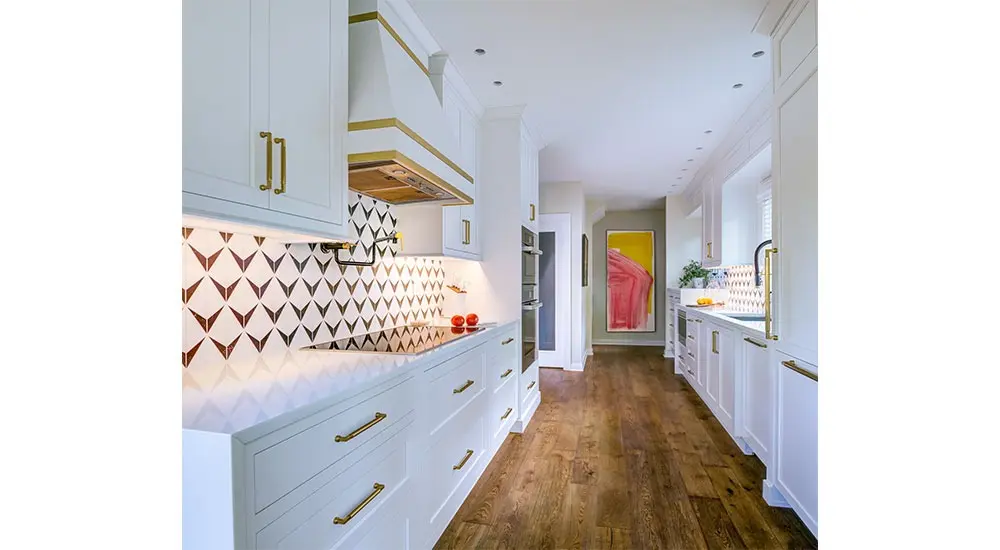
This exact logic extends far beyond the entryway threshold and the disguised bathroom grab bar. Comfort-height toilets can be thoughtfully specified even within a powder room where no one currently requires them. Electrical outlets and GFCI placements can be planned to intelligently anticipate wet countertops and changing mobility needs. Slip-resistant flooring materials can be utilized at every single wet-to-dry transition. An induction cooktop keeps an open flame entirely out of a kitchen frequented by small children or unsteady hands. These are fundamentally critical safety decisions cleverly dressed up as ordinary specification choices, which is precisely why they are so frequently omitted by builders focused solely on immediate bottom lines.
The Highest Form of Luxury
After years of working diligently at this vital intersection of architecture, health, and human longevity, the prevailing realization is that the most luxurious thing a modern home can offer is not the rarest imported marble or the most precise architectural millwork. Instead, true luxury is the quiet, unshakeable confidence that the space has been thought through completely. It is the assurance that the home will gracefully accommodate who a client is becoming and everyone who walks through their front door, honoring all stages of life rather than just the present moment. The clients who grasp this profound truth the earliest are invariably the ones who end up with the residences of which designers are proudest—not because they spent the most money, but because they asked the better, deeper questions from the very start.