It is midnight on a steamy August evening, and photographer Christopher Payne is standing in the middle of a Brooklyn-bound lane of the Hugh L. Carey Tunnel, better known as the Battery Tunnel, with a mischievous smile on his face. Recalling his college days four decades ago at Columbia University, when he would occasionally appropriate subway station signs as youthful souvenirs, Payne takes in his current surroundings with a sense of poetic irony. Now, he notes, he is being paid by the Metropolitan Transportation Authority (MTA) to go places he really shouldn’t be.
The tunnel has been temporarily closed to vehicular traffic for standard maintenance—specifically, to allow workers to scrub its 400,000 distinctive wall tiles—and to give Payne unprecedented access. For the past twenty years, Payne has built a vast, celebrated catalogue of industrial photography. In this late-night subterranean space, he is capturing an aspect of New York City’s sprawling transit network that the riding public never actually sees.
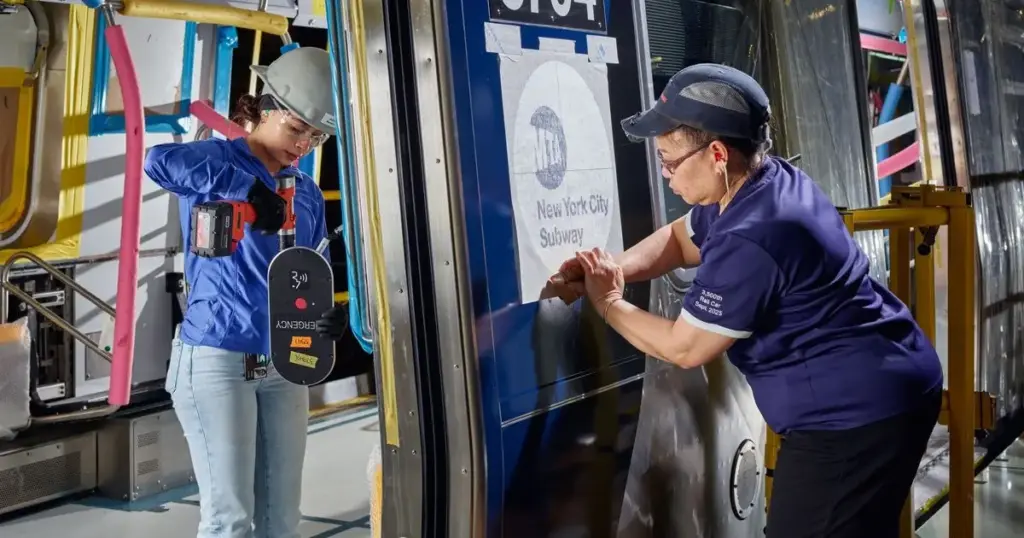
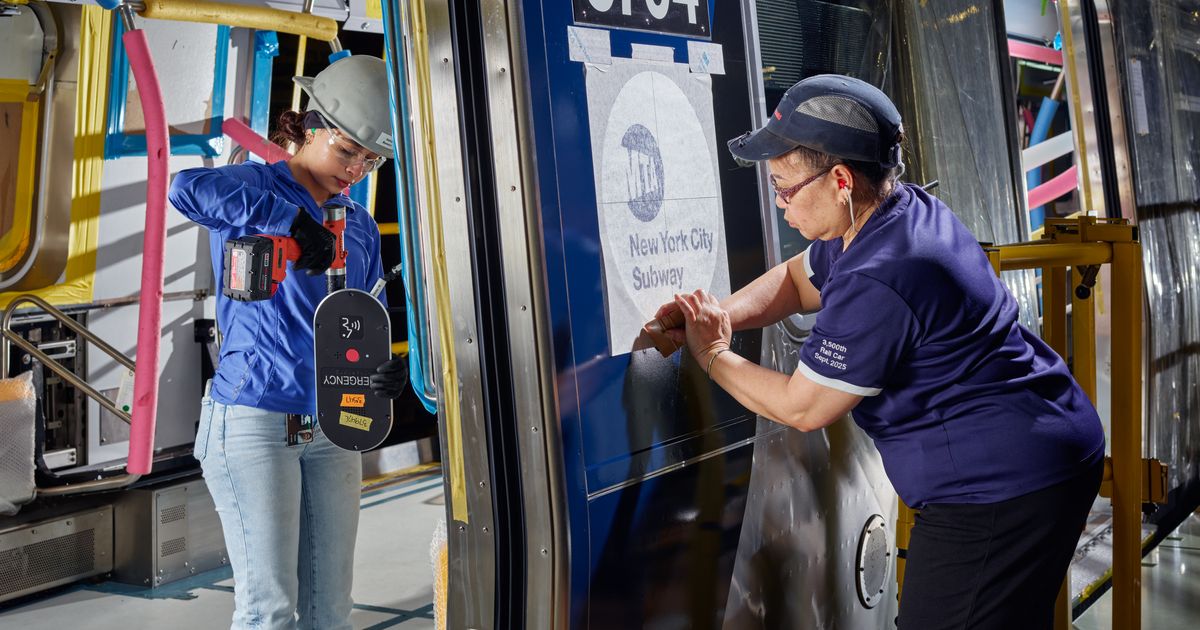
This behind-the-scenes exploration forms the core of “In Service: MTA Photographs by Christopher Payne,” a compelling new exhibition commissioned by MTA Arts & Design. Opening on September 22, the exhibition brings the hidden mechanics of public transit directly to the commuters who rely on them every day. Rather than burying these images in a traditional gallery space, the MTA has installed them inside 52 light boxes across five major subway stations, including Grand Central, Bowling Green, and Atlantic Avenue. Capturing these typically off-limits MTA sites required Payne to spend five months traveling across the country, a journey that sent him everywhere from crawling through a bustling bus manufacturing facility in Sacramento, California, to observing meticulous subway-car builders in Lincoln, Nebraska.
The physical demands of the project are considerable, requiring both patience and improvisation. On another recent day, the trim 57-year-old photographer could be found dangling from a narrow catwalk perched high atop the Marine Parkway-Gil Hodges Memorial Bridge. Surveying the breathtaking panoramic view from 200 feet above the Rockaway Inlet, Payne shouted down his initial impression: “This is great! But it’s too pretty!”
Even operating the bridge’s massive iron deck after traffic was halted failed to satisfy his artistic vision. Instead, Payne wanted to capture the perspective of looking outward from inside the bridge’s tiny control room, which is suspended directly above the four lanes of traffic. However, a grimy, weather-beaten window would not open wide enough to accommodate the necessary angles for his camera lens. Exhibiting the polite yet absolute persistence familiar to documentary photographers, Payne requested that the window be entirely removed. When ancient, rusted screws stripped and thwarted that plan, Payne and his assistant quickly improvised, rigging a custom support arm that allowed him to safely extend his lens three feet out the window toward a battleship-gray steel beam anchoring the 89-year-old span.
For Payne, documentary photography is never merely about recording facts or cataloging machinery. He is driven by what he calls the “wow factor”—the pursuit of something striking and genuinely beautiful hidden within the gritty reality of urban infrastructure.
Reflecting on his experiences and the dozens of images that make up the new exhibition, Payne highlights several key photographs that define the project and explains the intricate processes required to bring them to life.
Among the most striking subjects is the Hugh L. Carey Tunnel maintenance operation. Transit workers affectionately refer to the specialized cleaning rig as “the toothbrush.” When workers first proposed the tunnel as a subject, Payne admitted he had never previously considered how such a massive underwater artery was cleaned, let alone the scale of the machinery required to do it. The primary challenge for the photographer was making the routine maintenance look as exciting visually as it sounded in theory. Achieving this required fine-tuning the positioning of the cleaning arm’s mechanical reach and adjusting portable lighting fixtures so that workers Stefano Como and Rosario Mannino would not simply appear as dark silhouettes inside their utility truck. Preserving the human element, Payne notes, is vital because it reminds viewers that real people are actively performing the work, all before the truck eventually runs out of water and the shift concludes.
At the Marine Parkway-Gil Hodges Memorial Bridge, Payne sought to capture the intersection of raw architecture, structural design, and kinetic energy. Rather than relying on a traditional wide-angle lens that would distance the viewer, he wanted people to feel physically present in the space. By positioning himself in a mezzanine space where the stationary weight of the bridge converges with the motion of cars whizzing by below at 60 miles per hour, Payne captured the dramatic relationship between movement and solidity—a structural nuance easily overlooked by commuters rushing past.
Further inland, inside the Grand Avenue Central Maintenance Facility in Maspeth, Queens, Payne turned his lens toward the city’s omnipresent bus fleet. While every New Yorker recognizes the standard municipal bus, Payne aimed to present a familiar object in an entirely unfamiliar context. By photographing massive buses elevated on hydraulic jacks with their wheels completely removed, he focused on the geometric intersections where human workers and heavy machinery meet. Immersed deep within their work environments, the mechanics inside the machines create a compelling visual narrative.
Human labor remains a central theme at the Coney Island Overhaul Shop, where technician Conrad Samuels can be seen working meticulously on a gearbox for a subway car-wheel motor. Payne emphasizes that without a human presence, an image of an industrial object lacks narrative depth. By capturing Samuels carefully opening, cleaning, and regreasing the complex mechanical components, the photograph reminds commuters of the vast amount of specialized skill and manual labor required to keep the city’s complex machinery safely functioning day after day.
The journey also took Payne to the historic Richmond Hill train yard in Queens. Now operating as part of the Long Island Rail Road, the yard has been in continuous use since the 1880s and houses one of the city’s last functioning 19th-century railroad turntables. Initially, Payne envisioned a dramatic, illuminated night shot of a large commuter engine utilizing the historic mechanism. However, after hours of waiting and shooting normal-looking engines, the scene felt too ordinary. Just as he was preparing to pack up at eleven at night, yard workers brought in a smaller switch engine used for moving cars around the yard. The smaller locomotive moved with an unexpected grace, prompting Payne to snap a quick frame that ultimately inspired him to return months later with specialized equipment to capture the definitive shot now featured in the exhibition.