
The traditional acoustic guitar relies on a delicate orchestration of physics, geometry, and organic materials. For centuries, makers have turned to thin, resonant timbers—such as mahogany, spruce, and rosewood—to construct the hollow bodies that capture the vibration of steel or nylon strings and amplify it into a room-filling sound. But what happens when an artisan abandons timber entirely in favor of one of the earth’s most stubborn, heavy, and unyielding materials?
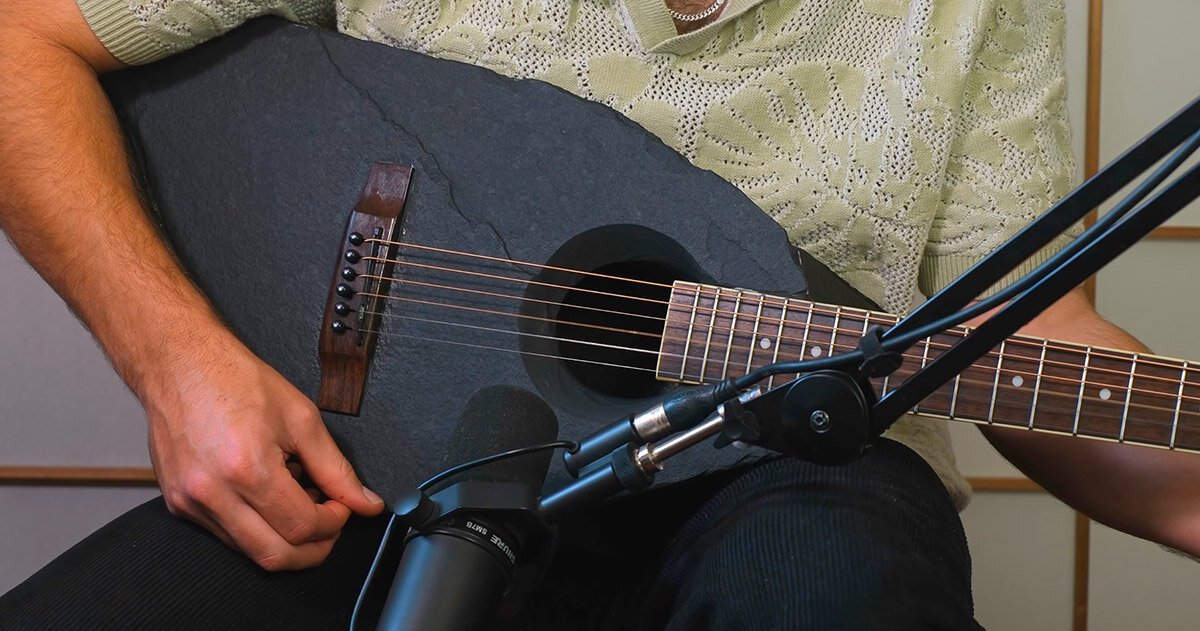
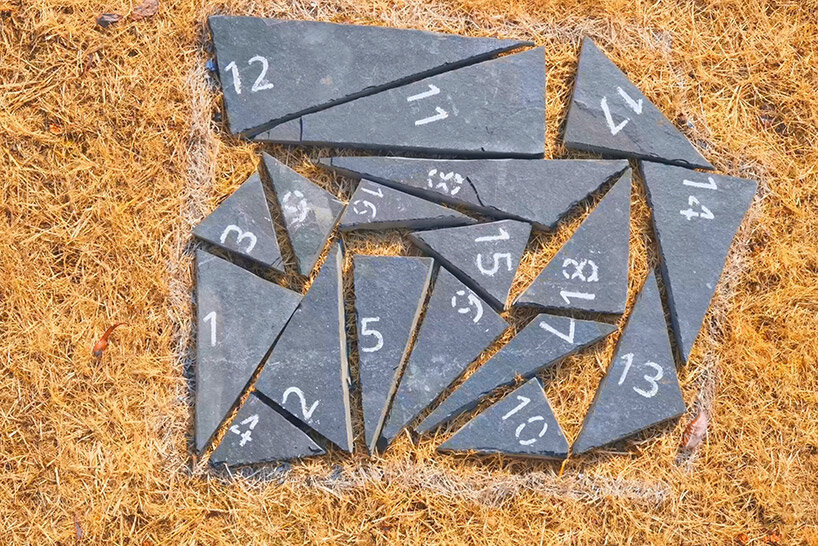
Content creator and maker BeBeau Builds sought to answer that very question in a recent ambitious engineering experiment. Rather than shaping the familiar wooden shell of a standard acoustic instrument, the maker designed and constructed a faceted, hollow guitar body assembled entirely from 18 individual pieces of natural slate. The resulting creation—weighing a staggering 48.7 pounds—defies conventional expectations of instrument design by managing to function as a genuine, playable acoustic guitar despite being carved from solid stone.
The unconventional project originated from an observation of acoustic properties rather than structural convenience. When struck on its own, a thick slab of slate emits a distinct, long-lasting metallic ring. This unique auditory behavior suggested that the stone possessed enough inherent resonance to vibrate effectively once it was shaped into a hollow enclosure. However, translating that acoustic potential into a functional instrument presented an immense physical challenge. Slate is notoriously heavy, its thickness naturally varies across quarried slabs, and a completed guitar must not only withstand the intense pulling tension of its strings but also remain ergonomic enough to rest against a human body during play.
From Flat Stone to a Faceted Hollow Shell
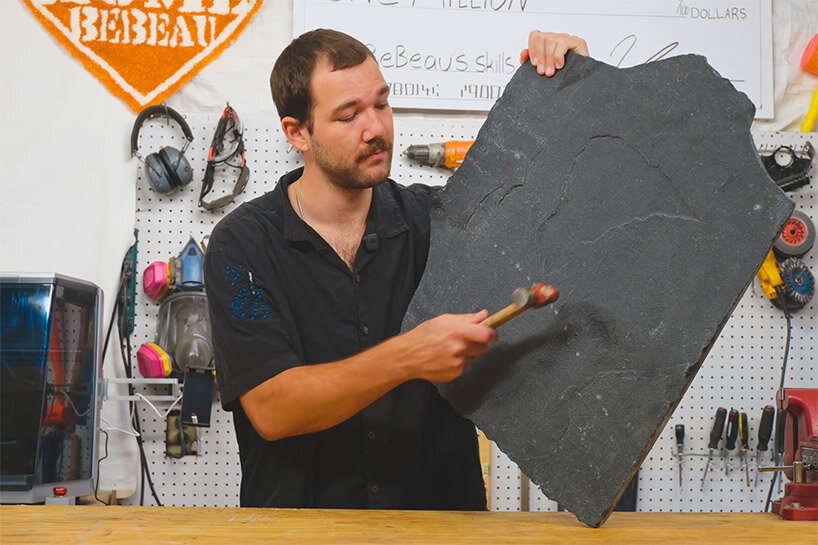
Developing the instrument required a meticulous design process. BeBeau Builds experimented with several conceptual body shapes before settling on an angular, faceted form capable of distributing stress and accommodating the geometric constraints of flat stone panels. To bring the design to life, the maker utilized 3D-printed templates to accurately transfer the complex geometries onto the raw slate material.
The fabrication process immediately encountered practical hurdles. Standard tile saws struggled to cut cleanly through the dense, inch-thick material. Furthermore, once the individual stone panels were successfully cut, their angled edges had to meet with microscopic precision to form a completely sealed volumetric chamber capable of housing a repurposed acoustic guitar neck.
The initial attempt at assembly exposed how quickly minute construction errors could compound. Although a 3D-printed internal frame had been carefully designed to position the 18 distinct stone sections, real-world variations in the slate quickly threw off the alignment. Individual panels ranged in thickness from roughly three-quarters of an inch to an inch and a quarter. These minor dimensional inconsistencies caused the cut angles to drift progressively further from the intended geometry as the body took shape. Ultimately, the discrepancies became too severe to ignore, forcing the maker to dismantle the entire structure and painstakingly scrape away the adhesive from the stone to start anew.
Reassessing Structure and Adapting to the Material
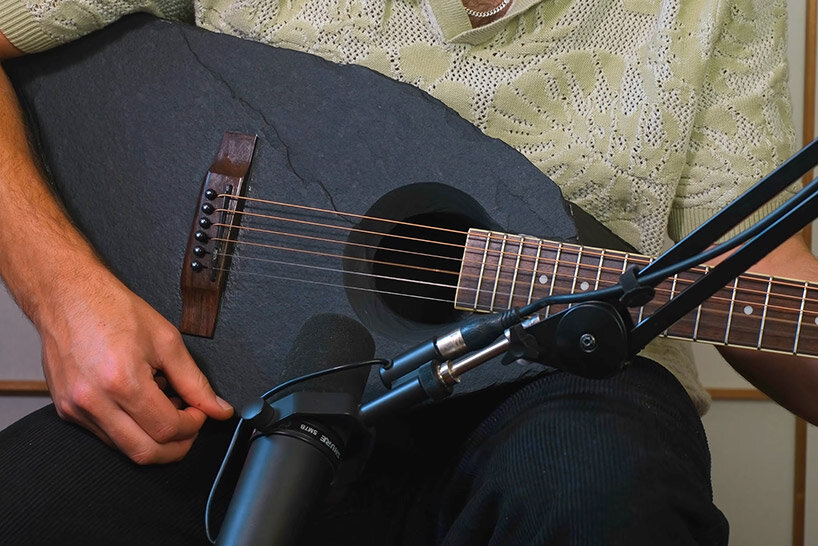
For the second assembly attempt, BeBeau Builds shifted strategy, working outward from the exterior dimensions rather than relying strictly on an internal digital skeleton. Hot glue was employed to temporarily hold the heavy slate panels in position, creating a makeshift exterior structure while robust construction adhesive was injected into the irregular joints to cure over the course of several days.
This adaptive approach allowed the slate to behave according to its own physical characteristics, with each piece adjusted directly against its neighbor rather than being forced to conform to a rigid, idealized mold. During the fabrication phase, one of the primary stone panels inevitably fractured under the stress and had to be completely replaced. Once the shell was unified, gaps between the sections were carefully filled, and the entire slate body received a coat of mineral oil to deepen its natural dark hue before the hardware and strings were finally installed.
By this stage in the process, the object bore the unmistakable proportions of a traditional acoustic guitar body, yet it had been entirely translated into a heavy, hard-edged shell of planar stone surfaces.
The Surprising Sound of a Stone Guitar
When the completed instrument was finally strung and strummed for the first time, the most striking revelation was just how ordinary it sounded. Given the drastic shift in material, BeBeau Builds had anticipated that the stone body would completely distort or radically alter the voice of the instrument. Instead, the initial open chords produced a tone surprisingly close to that of a conventional wooden acoustic guitar.
The acoustic performance did, however, bear distinct differences. The slate version yields a softer voice, and its notes tend to decay and fade much sooner than they would on a resonant wooden soundboard. The overall timbre shifts slightly, yet the thick front plate still manages to vibrate adequately, moving enough air to produce a recognizable and authentic acoustic sound profile.
Despite its acoustic success, the instrument’s physical limitations quickly become apparent during extended playing sessions. Weighing nearly 49 pounds, the slate guitar is extraordinarily heavy and uncomfortable to rest across a human lap for long periods. Additionally, the salvaged neck rests at an imperfect angle due to the rigid nature of the assembly, making the strings noticeably harder to press down against the fretboard and inadvertently pulling certain notes sharp under finger pressure.
Even with these formidable ergonomic hurdles, the project successfully answers its core question. A guitar body can indeed be cast entirely from a heavy stone shell and continue to function as an operational musical instrument, proving that the most profound transformations in experimental lutherie often lie not in an entirely alien voice, but in the sheer weight and physical reality of the materials we choose to shape.