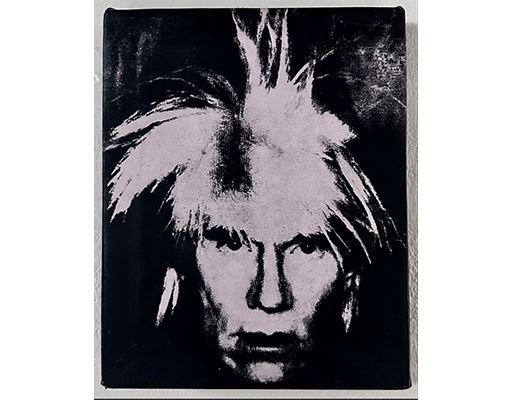
In a notable convergence of art history and market provenance, Bonhams’ flagship gallery at 111 West 57th Street is currently hosting a compelling exhibition that brings together the contrasting eras of Andy Warhol’s illustrious career. Central to this public display, which runs through October 8, is the artist’s haunting 1986 Self-Portrait, a late-career masterpiece that offers a profound window into the psyche of the man who redefined contemporary art.
The exhibition has drawn significant attention, not only for the caliber of the works on display but also for the specific narrative threads that link the pieces. Among these, the 1986 Self-Portrait, consigned by MutualArt, stands out as a visceral testament to Warhol’s final creative period. Executed in synthetic polymer paint and silkscreen ink on canvas, the work is immediately recognizable for the iconic "fright wig" motif. This series, created just months before the artist’s unexpected death in early 1987, is widely regarded by scholars and collectors alike as one of the most reflective and introspective examinations of his own identity.
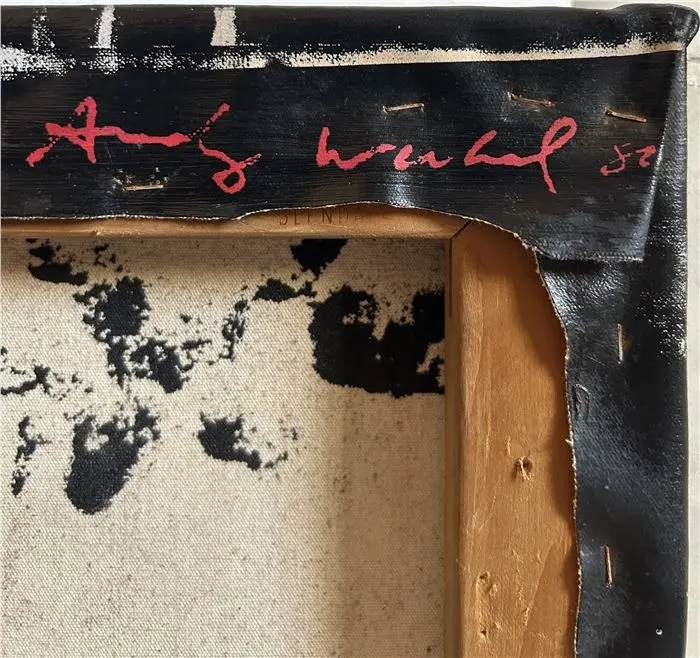
The history of the piece adds an intimate layer to its public presentation. The canvas was acquired directly from artist and long-time Warhol assistant Ronnie Cutrone in 1986. This provenance is particularly significant; as a key member of the Factory circle, Cutrone was instrumental in the execution and realization of many of Warhol’s projects during the 1970s and 80s. Having the work emerge from such a close associate underscores its authenticity and its place within the artist’s inner sanctum. The reverse of the canvas, which reveals the artist’s signature on the fold, serves as a quiet, physical reminder of the hand of the master during his final months.
To provide a broader context for the evolution of his style, the 1986 Self-Portrait is being exhibited alongside two companion portraits of Miriam Davidson, dating to 1965. These earlier works, rendered in acrylic spray paint and silkscreen ink on linen, offer a sharp stylistic counterpoint to the later self-portrait. Where the 1986 piece is stark, skeletal, and deeply personal, the 1965 commissions represent the height of the Factory’s commercial portraiture era, characterized by a certain detachment and a meticulous focus on the art of replication.
The juxtaposition of these two periods—the mid-1960s, a time of meteoric rise and the cementing of the "Pop" aesthetic, and the mid-1980s, a time of introspective, almost spectral output—allows viewers to trace Warhol’s lifelong obsession with the themes of identity, fame, and the mechanics of image-making. Both the 1986 self-portrait and the 1965 Miriam Davidson canvases are documented in The Andy Warhol Catalogue Raisonné, the definitive scholarly record of the artist’s work. Their presence together at Bonhams creates a dialogue that spans two of the most critical decades in 20th-century art history, highlighting how Warhol moved from the celebration of the surface to a more somber engagement with his own mortality.
The curation of the space at 111 West 57th Street serves to elevate these works further by placing them within the company of other modern masters. The exhibition also features significant works by Georgia O’Keeffe, Marc Chagall, Roy Lichtenstein, Pierre Bonnard, and Tamara de Lempicka. This eclectic yet prestigious grouping emphasizes the enduring relevance of 57th Street as a central axis of the global art market. Long before the shift of the contemporary art scene toward the gallery districts of Chelsea, 57th Street served as the epicenter of New York’s high-culture landscape. It was here that institutions like the Art Students League and historic venues like Carnegie Hall anchored a neighborhood that fostered pioneering dealers such as Paul Durand-Ruel, Betty Parsons, Sidney Janis, and the Pace Gallery. By returning to this historic site, the current exhibition at Bonhams reconnects with the tradition of elite art dealing that helped define the New York art market in the post-war era.
It is worth noting a correction regarding the exhibition’s logistics: a previous version of this report incorrectly stated that the two 1965 Miriam Davidson portraits were consigned by MutualArt. In fact, MutualArt has exclusively consigned the 1986 Self-Portrait, which is currently on display alongside the Davidson canvases as part of the broader gallery exhibition. The distinction is an important one, as it clarifies the specific contributions of various stakeholders in bringing these museum-quality works to the public eye.
For the Post-War and Contemporary Art Department at Bonhams, this presentation is more than just a public showing; it is an opportunity for collectors to engage with works of rare historical weight. The 1986 Self-Portrait, in particular, represents a pinnacle of late-career artistry. In the history of Warhol’s output, the final years are often viewed as a period of renewed vitality and stark vulnerability. The "fright wig" self-portraits, with their high-contrast palette and haunting composition, strip away the celebrity veneer that defined his earlier work, leaving behind an image that is both iconic and deeply human.
.Jpeg)
The exhibition provides an essential opportunity for both seasoned collectors and the general public to view these pieces in a shared space. By placing the 1986 canvas in direct conversation with the 1965 portraits, Bonhams allows for a nuanced understanding of Warhol’s technical development—from the vibrant, multi-layered color applications of his early career to the more somber, direct approach of his final year. The inclusion of these pieces among masterworks by artists such as Lichtenstein and O’Keeffe further reinforces their status as central pillars of the modern canon.
As the exhibition continues through October 8, the gallery at 111 West 57th Street serves as a temporary sanctuary for those interested in the history of American art. The interplay between the different eras represented by these paintings offers a rare, cohesive narrative that is seldom seen in a commercial gallery setting. For those who view art as a continuous thread of human expression, the opportunity to study the transformation of Warhol’s vision—from the mid-sixties fascination with the celebrity image to the late-eighties confrontation with the self—is a compelling draw.
The exhibition at Bonhams stands as a testament to the enduring power of the Warhol name and the ongoing importance of provenance in the art world. Each brushstroke, each layer of ink, and each signature on the fold of the 1986 canvas serves as a bridge to a past that continues to inform our contemporary understanding of art, identity, and the market. Visitors are encouraged to take advantage of the remaining time to experience these works firsthand, as they provide a uniquely intimate look at one of the most consequential figures in art history. Those interested in further information regarding the exhibition or the specific works on view are invited to visit the gallery at 111 West 57th Street or consult the latest updates through professional art channels.