Long before he became a giant of American art—celebrated globally for his massive, rhythmic canvases and some of the most commanding valuations in the art market—Jackson Pollock was simply a 20-year-old student trying to keep his head above water in New York City. Living in a modest, cramped West Village space shared with his older brother and sister-in-law, the young artist was years away from developing the revolutionary drip-painting technique that would forever alter the trajectory of modern abstract expressionism.
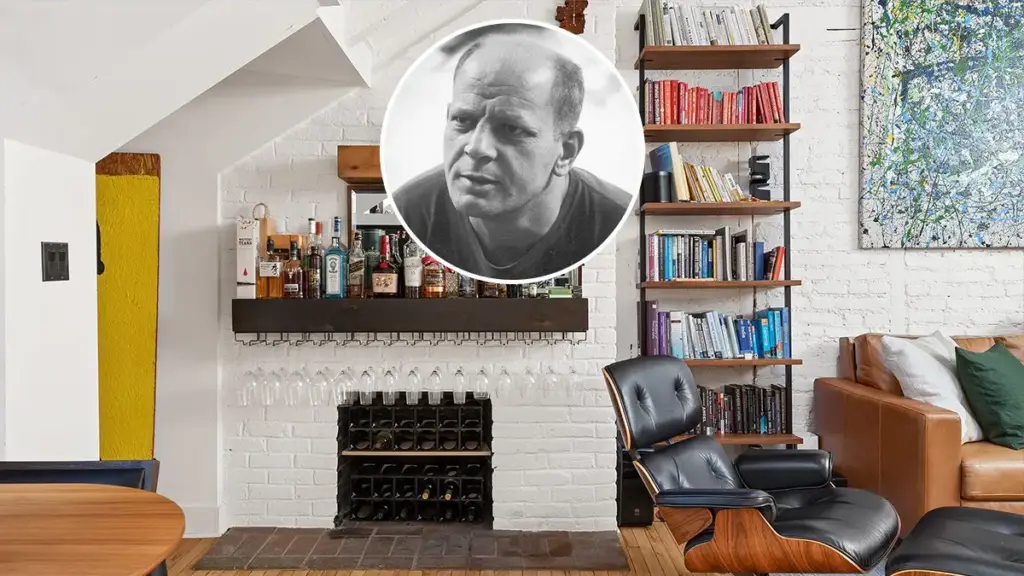
Now, a tangible piece of that formative history is up for grabs. The top-floor apartment where Pollock once lived and worked during the depth of the Great Depression has officially been listed for sale. Located at 46 Carmine Street, the roughly 690-square-foot one-bedroom residence is currently on the market with Shane Boyle of Compass, priced at $1.99 million. While the space has undergone considerable modernizing transformations over the decades, it retains a distinct link to an era when American art was quietly undergoing a radical, subterranean evolution.
A Humble Beginning on Carmine Street
Between 1932 and 1933, a youthful Pollock occupied the top-floor quarters of the Carmine Street property alongside his older brother, Charles Pollock, and Charles’s wife, Elizabeth. Far removed from the spacious, light-flooded industrial artist lofts that would later define the romanticized mythology of New York bohemia, this two-room residence was remarkably tight on space. The apartment functioned as a dual-purpose dwelling and working studio: Charles utilized the front room for his own artistic endeavors, while Jackson set up his workspace in the back.

During these lean years, Pollock was scraping by amidst the profound economic devastation of the Great Depression. He was actively striving to establish his footing as a serious painter, refining his craft while studying under the influential regionalist painter Thomas Hart Benton at the nearby Art Students League. More than a decade would slip by before Pollock finally broke away from traditional figurative styles to experiment with pouring and splattering enamel paint directly onto unprimed canvas spread across a studio floor—the very technique that catapulted him to international fame.
The Evolution of a Historic Space
Though the ghosts of Pollock’s early struggles still linger within the walls, the physical layout and amenities of 46 Carmine Street have evolved significantly since the early 1930s. The cozy one-bedroom apartment now boasts soaring 14-foot ceilings that amplify a sense of volume and space, complemented by four expansive skylights that flood the interior with natural daylight. Original architectural character is woven throughout the floor plan via exposed brick walls and warm hardwood floors, which are paired with a thoroughly updated kitchen and contemporary bathroom. Additionally, the residence features a versatile loft space that easily accommodates a modern home office or an artist’s studio.
The property itself is nestled within a classic Federal-style brick townhouse constructed in 1827. Standing as a physical testament to early 19th-century Manhattan architecture, the building earned official recognition when it was incorporated into the Greenwich Village Historic District in 2010, preserving its historic streetscape presence on leafy Carmine Street.

A Contemporary Chapter of Art History
The apartment’s recent history adds yet another creative layer to its storied past. The current owner, entrepreneur Fergus Hurley, cultivated his own artistic connection to the space after relocating from Ireland to New York in 2020. Initially leasing the apartment during the onset of the pandemic, Hurley ultimately decided to purchase the property off-market the following year.
Utilizing the apartment’s versatile loft as a creative sanctuary during lockdown, Hurley channeled the spirit of the space’s most famous former resident. He produced a large-scale abstract painting directly inspired by Pollock’s legacy, remarkably utilizing salvaged wooden boards that had previously covered SoHo storefronts during the widespread 2020 George Floyd protests.
Now dividing his time between Miami and San Francisco, Hurley has placed the residence on the open market. While the Pollock-inspired abstract piece created by Hurley is not automatically included in the asking price, prospective buyers have the option to negotiate for the artwork separately.

A Timely Listing Amid Major Museum Retrospectives
The return of 46 Carmine Street to the real estate market coincides with heightened public and scholarly interest in the artist’s foundational years. The Metropolitan Museum of Art is currently hosting a major comprehensive exhibition titled Krasner and Pollock: Past Continuous. The extensive showcase brings together more than 120 works created by both Jackson Pollock and his wife, fellow trailblazing abstract expressionist Lee Krasner, running through January 31, 2027.
While whoever ultimately purchases the historic West Village property will not find themselves sharing tight quarters with a struggling, unknown art student, they will undoubtedly acquire a rare piece of Manhattan folklore. For the next custodian of 46 Carmine Street, the walls offer far more than just exposed brick and natural light—they provide a direct connection to the quiet, arduous beginnings of American modern art.