Researchers have successfully demonstrated for the very first time that quantum fluctuations within a vacuum can be harnessed to strengthen superconductivity. This landmark achievement opens a promising and entirely novel pathway for the precise control and manipulation of unusual states of matter without the need for direct external energy excitation.
The groundbreaking study, which has been published in the prestigious scientific journal Nature, was spearheaded by a collaborative team of prominent physicists. The research was led jointly by Professors Changgan Zeng and Guanghui Cheng of the University of Science and Technology of China, operating under the auspices of the Chinese Academy of Sciences. The international and cross-institutional collaboration also heavily featured contributions from Professor Qingdong Jiang of Shanghai Jiao Tong University, Nobel laureate Professor Frank Wilczek of the Massachusetts Institute of Technology, alongside other esteemed colleagues in the field of quantum physics.
Empty Space Is Not Truly Empty
In the vernacular of everyday language, the word "vacuum" typically evokes the image of a completely empty space—a void devoid of matter, energy, and activity. However, modern quantum physics paints a vastly different, far more dynamic picture of the universe at its most fundamental level.
According to the principles of quantum electrodynamics and Werner Heisenberg’s famous uncertainty principle, even the absolute lowest energy state of a system can never be truly still or inert. Instead, virtual particles are continuously created and annihilated in fractions of a second, producing an ever-present, bubbling background of quantum fluctuations.
These fluctuations are far from being merely theoretical mathematical constructs. Over the decades, their tangible physical effects have been thoroughly observed, measured, and verified through well-established phenomena in modern physics, such as the Lamb shift in atomic spectra, the spontaneous emission of light from excited atoms, and the Casimir effect, which causes uncharged conductive plates to experience an attractive force in a vacuum.
For several years, the research teams led by Professors Zeng and Cheng have dedicated their efforts to investigating how these persistent vacuum fluctuations might influence condensed matter systems. In a notable earlier study, the researchers demonstrated that they could directly manipulate vacuum fluctuations by utilizing an applied magnetic field to reversibly switch the Casimir force between a state of physical attraction and one of repulsion.
That successful result, however, naturally raised a much larger and more ambitious question within the physics community: Could quantum vacuum fluctuations also be effectively utilized to control macroscopic quantum states of matter?
Turning the Vacuum Into a Control Tool
Concurrently, Professor Jiang’s research group approached this fundamental problem from a deeply theoretical perspective, studying how specially engineered quantum vacuum environments might interact with and influence various complex states of matter.
To formalize this approach, the researchers introduced the conceptual framework of "vacuumronics." In this emerging paradigm, specially designed vacuum environments are utilized to govern and control electronic and photonic behavior at microscopic and macroscopic scales. This theoretical groundwork ultimately provided the vital analytical framework necessary for understanding the remarkable superconductivity enhancements observed in the team’s subsequent experiments.
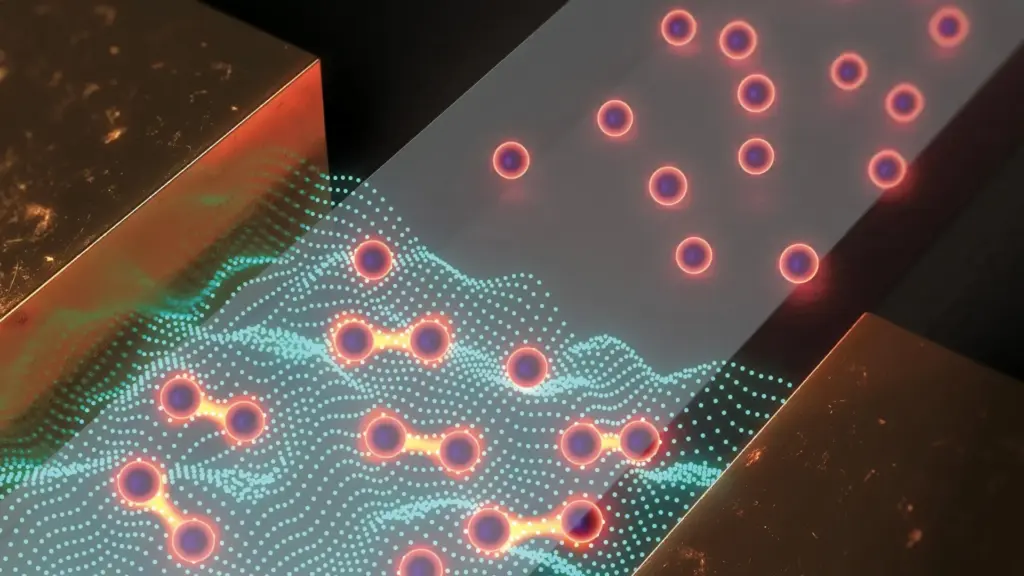
"Vacuum fluctuations in free space are generally far too weak to produce observable effects in macroscopic condensed-matter systems," explained Professor Zeng, elaborating on the experimental hurdles the team had to clear. "To overcome this fundamental limitation, we introduced a terahertz split-ring resonator. Such a dark cavity can effectively reshape the local electromagnetic environment and substantially amplify vacuum fluctuations."
To test this bold hypothesis experimentally, the researchers placed a sample of the transition metal dichalcogenide superconductor niobium diselenide ($textNbSe_2$) inside a terahertz dark cavity. This setup successfully created a tightly coupled system in which the superconducting material interacted intimately with the specially engineered, resonant electromagnetic environment housed within the cavity walls.
The research team then meticulously compared the material’s superconducting behavior when situated inside the cavity versus when it was outside. The empirical results were striking: placing the $textNbSe_2$ sample inside the cavity significantly increased its superconducting critical temperature, which defines the precise threshold temperature below which the material transitions into a zero-resistance superconducting state.
Superconductivity Gets Stronger
"We observed that the critical temperature can increase by up to 5.4% in a six-layer $textNbSe_2$ device, while the critical current and critical magnetic field are significantly enhanced near the superconducting transition," noted Professor Cheng, highlighting the precision of the measurements. "This represents the very first experimental observation of vacuum-fluctuation-enhanced superconductivity."
To ensure the validity of these extraordinary findings, the researchers conducted an extensive series of rigorous control experiments. Their goal was to definitively determine whether the observed enhancement could instead be explained by more conventional, mundane alterations to the physical material itself.
To this end, the team systematically varied multiple properties of the experimental setup, including the cavity geometry, the characteristic resonance frequency, the thickness of the material samples, the choice of dielectric materials, and the configuration of the metallic strips. The comprehensive data gathered from these controls allowed the physicists to conclusively rule out alternative explanations involving mechanical strain, material degradation, structural inhomogeneity, and metallic screening effects.
One of the most compelling clues supporting their conclusion emerged from the direct relationship observed between the degree of superconductivity enhancement and the characteristic frequency of the dark cavity. Rather than changing in a smooth, indiscriminate manner, the enhancement exhibited a sharp, resonance-like peak when tuned to one particular frequency.
"This result, which is closely tied to the cavity’s intrinsic photonic properties, provides strong experimental evidence of the coupling between the superconducting state and dark-cavity modes," Professor Zeng emphasized.
Virtual Photons May Explain the Effect
To formulate a comprehensive physical explanation for these observations, Professor Jiang’s theoretical team, alongside Professor Wilczek, developed a robust theoretical model grounded in the established Ginzburg-Landau framework of superconductivity.
Their theoretical interpretation suggests that the superconducting state continuously exchanges virtual photons with the engineered dark cavity. This ongoing quantum interaction effectively lowers the ground-state energy of the superconducting system, making the superconducting phase inherently more stable and, consequently, strengthening its macroscopic properties.
"When the characteristic energy of the cavity mode matched the low-energy superconducting fluctuations, the $textNbSe_2$ device exhibited a resonant enhancement, producing the peak in superconductivity enhancement that we recorded in the lab," Professor Jiang explained.
This profound result fundamentally alters the traditional way physicists conceptualize the vacuum. Rather than serving merely as an empty, inert backdrop upon which physical events transpire, the quantum vacuum can potentially be engineered and manipulated to actively dictate the behavior of matter itself.
"In most practical physics, the vacuum serves merely as the passive stage on which phenomena play out. This work shows that the background itself can become an actor—engineered to strengthen superconductivity and reshape the behavior of quantum matter," remarked Professor Wilczek.
A New Way To Control Quantum Matter
Crucially, this innovative approach achieves a strengthening of superconductivity without the need to directly drive the material using an external energy source, such as optical pumps or electrical currents. Instead, the researchers effectively reshape the surrounding vacuum environment, providing an entirely noncontact method for influencing a delicate quantum state of matter.
In the long term, this technique could make engineered vacuum fluctuations a versatile and powerful new control mechanism for superconductors, topological materials, and a wide array of other advanced quantum systems.
"With further optimization of cavity structures and material systems, vacuum-fluctuation coupling may enable more pronounced and widely applicable control of quantum states," concluded Professor Zeng.