By Benjamin Blake Evemy / MutualArt
02 October, 2026
The art of Franz Ritter von Stuck serves as a portal into a subterranean landscape of the human experience. As a seminal German painter, sculptor, printmaker, and architect, Stuck carved out a legacy defined by his ability to render the intangible—ancient mythologies, the raw ache of human desire, and the encroaching fog of psychological turmoil—with a visceral clarity that few of his contemporaries could match. While the depiction of mythological figures was a staple of the late 19th and early 20th-century artistic canon, Stuck’s approach transcended mere academic illustration. He imbued his subjects with a distinctive, mystical charge, pulling the viewer headfirst into realms that feel both primordial and disturbingly modern.
The Mythic Duality: Strength and Suffering
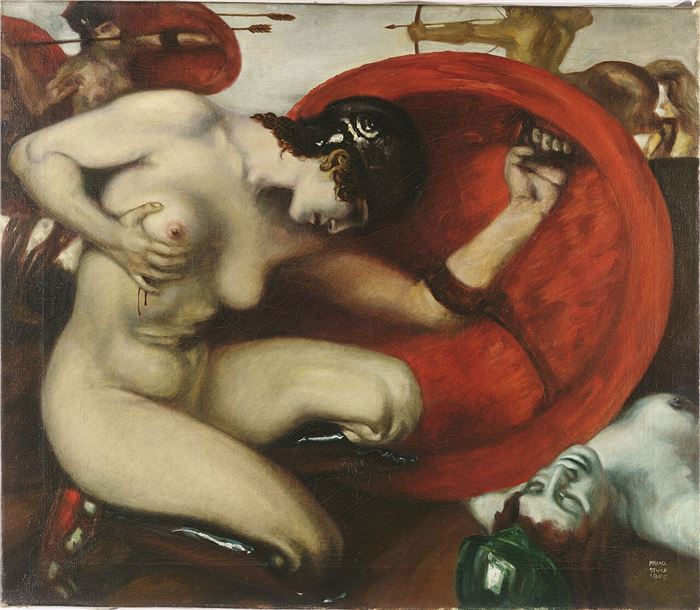
Stuck’s 1905 oil on canvas, Wounded Amazon, provides a poignant entry point into his thematic preoccupations. The work captures an Amazon in the midst of a brutal, bloodied confrontation against the Centaurs. The subject is caught in a moment of physical vulnerability; wounded by an arrow, she sinks to her haunches, clutching her breast in a gesture that manages to be simultaneously agonizing and deeply sensual. Darkened blood seeps from the unseen wound, while beside her, a fallen comrade lies supine—a pale, cadaverous figure that appears to remain in the fray even in death, her hand still supporting a raised shield.
This composition serves as a masterclass in the duality of the Amazonian archetype: the intersection of extreme, formidable warrior prowess and the inescapable fragility of the female form. Although this specific encounter is not explicitly recorded in the classical tales of antiquity, it resonates with the broader mythological tradition where both Amazons and Centaurs served as adversaries to the heroes of old. Stuck does not merely paint a battle; he paints the psychological cost of the conflict, focusing on the intimate, private tragedy hidden within the grander scale of myth.
The Sisyphusian Struggle and the Stygian Void
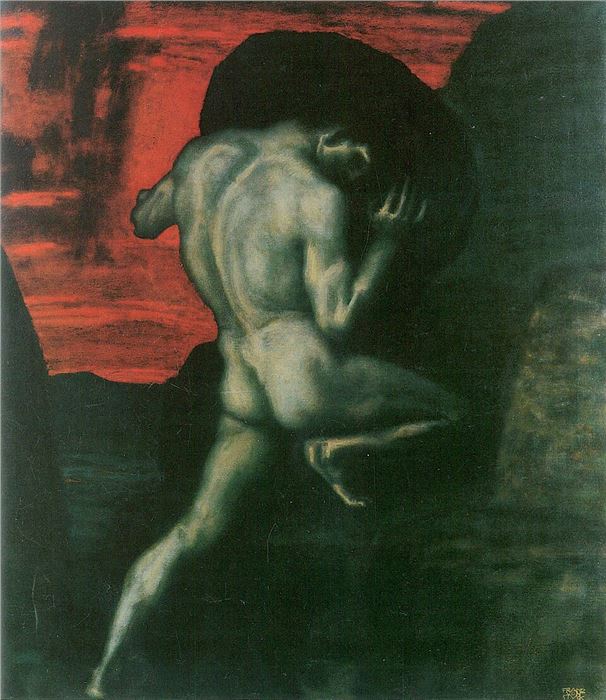
If the Amazon represents the fragility of the hero, Stuck’s 1920 painting of Sisyphus captures the exhaustion of the soul. The legend of Sisyphus—the Greek king condemned by the gods to push a boulder up a hill for eternity only to see it roll back down at the final moment—is a classic meditation on the futility of human existence. In Stuck’s hands, however, the allegory is stripped of its philosophical distance and rendered with brutal immediacy.
Against an infernal, red-streaked sky characterized by charcoal-colored clouds, Sisyphus is depicted in the throes of his perpetual, back-breaking labor. His figure is defined by strained, muscular tension, his face a mask of gloom, utterly devoid of the promise of rest. The painting relies on the visceral contrast between the pale, corpse-like flesh of the reprobate and the ink-black darkness of the Hades landscape. It is a haunting study in entrapment, where the "Stygian vault" becomes a metaphor for the relentless, repetitive nature of life’s darker burdens.
Divine Light and the Fallen Star
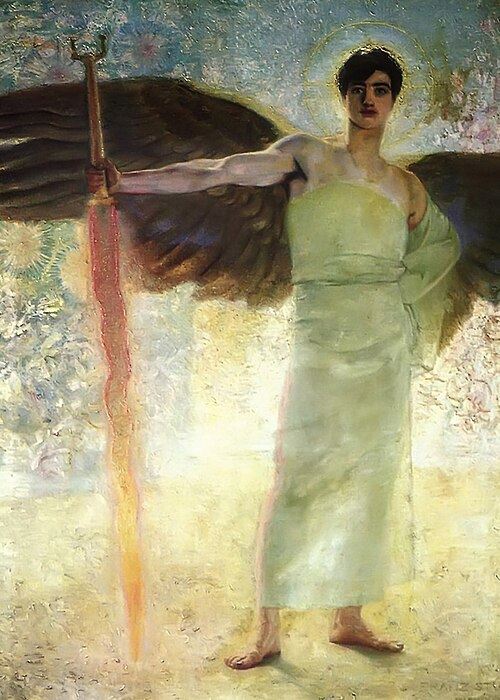
Stuck’s early career was punctuated by his profound engagement with religious and cosmic themes, often juxtaposing the celestial with the sinister. His 1889 masterwork, The Guardian of Paradise, stands as his first major oil painting and a turning point in his career, earning him a gold medal at the Munich Glaspalast. The painting depicts an angel standing with an air of cold authority, holding a searing sword. With feathered wings outstretched and a gilded halo encircling an androgynous, inscrutable face, the figure is framed by the blinding, albescent light of paradise, which spills forth in a blanket of exploding stars. It is an image of divine purity and, perhaps more importantly, the uncompromising strength of the righteous.
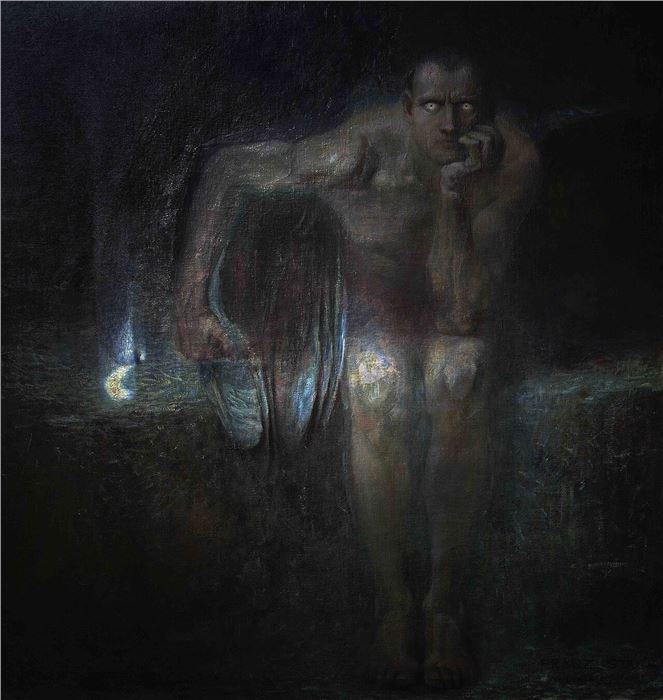
Yet, this preoccupation with the divine found its dark reflection just a year later in his 1890 masterpiece, Lucifer. Here, the "Morning Star" is not a caricature of evil but a figure of terrifying, quiet intelligence. His eyes are piercing pinpricks set in off-white irises, fixed directly on the viewer. While his pose—reminiscent of the traditional "Thinker"—suggests deep contemplation, there is a simmering, molten rage held just beneath the surface. This is evidenced by his clenched right hand, which appears poised to strike, and the strained, tense musculature of his arm.
Stuck employs subtle, eldritch elements to heighten this effect, such as the metallic, shimmering blues that define his draped wings and the ledge upon which he sits. These elements swirl like moving water, creating an impression of fluidity that is interrupted by a mysterious, oversized teardrop falling from the shadows. This teardrop, casting a crescent-moon reflection, serves as a poignant analogy for Lucifer’s cataclysmic descent from grace. It is a work that demands confrontation, forcing the viewer to engage with the fallen angel on his own terms.
The Allure of Sin and the Shadow of History
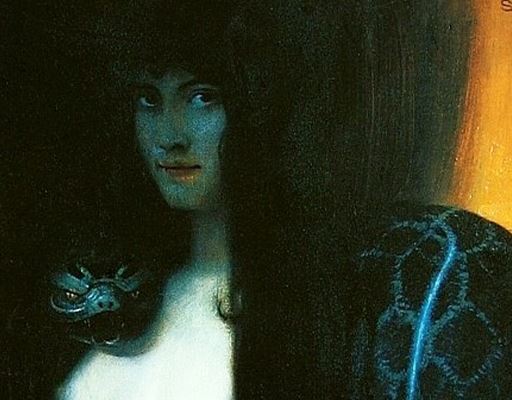
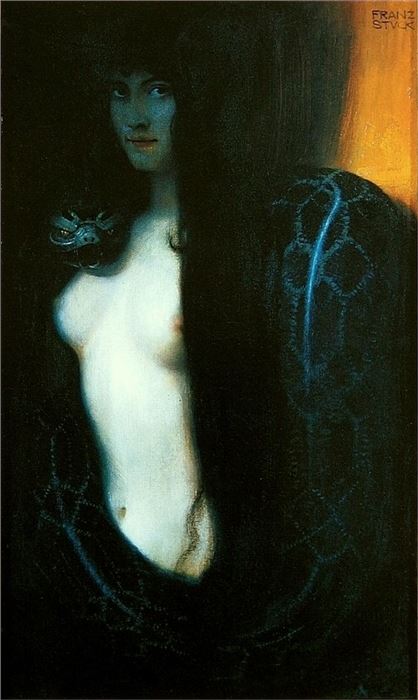
Perhaps no work better captures the intersection of desire and dread than The Sin (1893). In this iconic painting, Eve is depicted with a coiled serpent as her only garment. She wears a faint, enigmatic smile—a nod to the Mona Lisa—that suggests a knowing, darker wisdom. This is not the subservient Eve of traditional theology, but rather a figure that leans toward the archetype of Lilith. The deep, leech-black skin of the serpent, which seems to bleed into the texture of Eve’s own hair, creates a high-contrast chiaroscuro against her pallid, glowing skin. It is an invocation of both Eros and Thanatos—the life force and the death drive—bound together in a single, provocative image.
Stuck was so taken with this motif that he produced approximately a dozen versions throughout his life, with one notably enshrined on his own Künstleraltar (Artist’s Altar). The psychological weight of the piece was not lost on his contemporaries; Carl Jung, the pioneering psychologist, frequently praised the work for its complex, unsettling admixture of lust and anxiety.
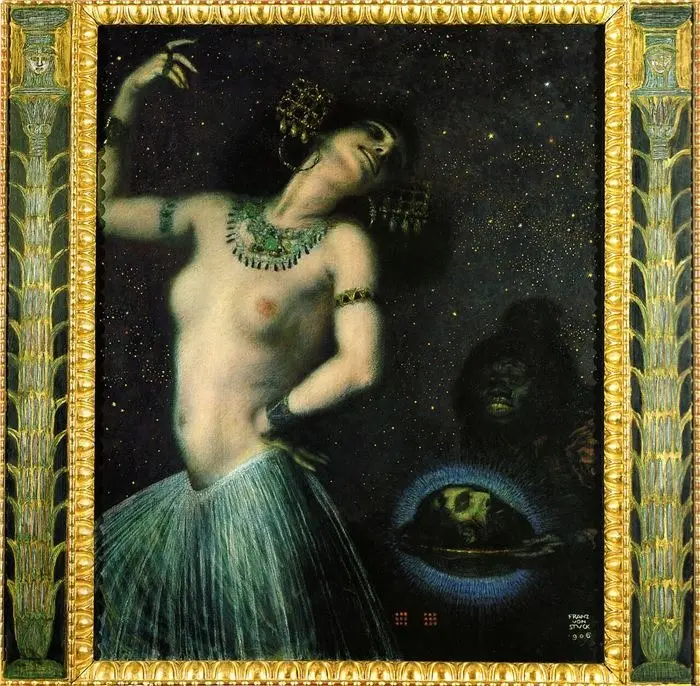
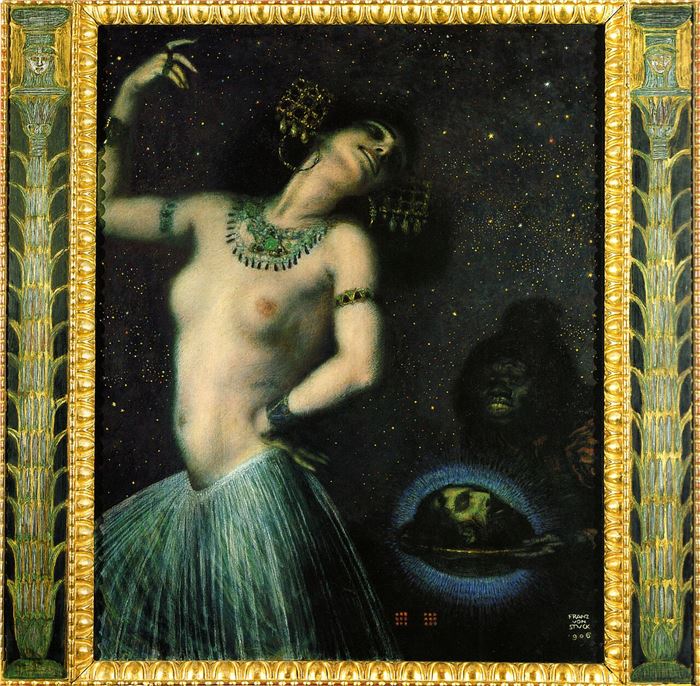
This capacity to tap into the darker currents of the collective psyche was a hallmark of Stuck’s career, though it also cast a long shadow over his legacy. His 1906 painting Salome, which depicts the biblical figure dancing under a nocturnal sky while a servant presents the severed head of John the Baptist, highlights his obsession with the seductive and the macabre. The painting’s composition—the elongated neck, the smudged, heavy-lidded eyes, and the deliberate emphasis on the curves of her form—perfectly encapsulates the dangerous sway Salome held over Herod.
While the disappearance of a third version of Salome during the chaos of the Second World War remains a footnote in art history, it invites a deeper, more uncomfortable reflection on the artist’s reception. Franz von Stuck was famously a favorite of Adolf Hitler, and some historians have speculated on the influence of Stuck’s early, more aggressive works, such as the 1889 Wilde Jagd (Wild Hunt), on the aesthetic sensibilities of the era. Whether this is mere coincidence or a prophetic alignment of imagery, it adds a layer of historical complexity to an already intense body of work.
A Legacy of Immersion
In his later years, as seen in his 1923 Self-Portrait, Stuck maintained a commitment to the visionary. By moving away from the rigid, technically obsessed style of the Neo-classicists and Academics, he liberated his subjects from the limitations of the "canvas-bound set." His figures do not merely pose; they inhabit complete, self-contained worlds.
Ultimately, Franz von Stuck’s brilliance lay in his ability to craft environments that do not merely present a scene to the observer, but rather pull the viewer into an all-consuming atmosphere. Through his masterful use of chiaroscuro, his fascination with the intersection of myth and the subconscious, and his unflinching gaze at the darkest aspects of the human condition, Stuck transformed the act of viewing art into an immersive, and at times harrowing, journey into the soul. His work remains a testament to the power of the Symbolist movement, proving that even a century later, the shadows he painted continue to resonate with an unsettling, timeless truth.